
Plater, Pipe Fitter, Mechanical Fitter: Who Does What on a Job
Published on
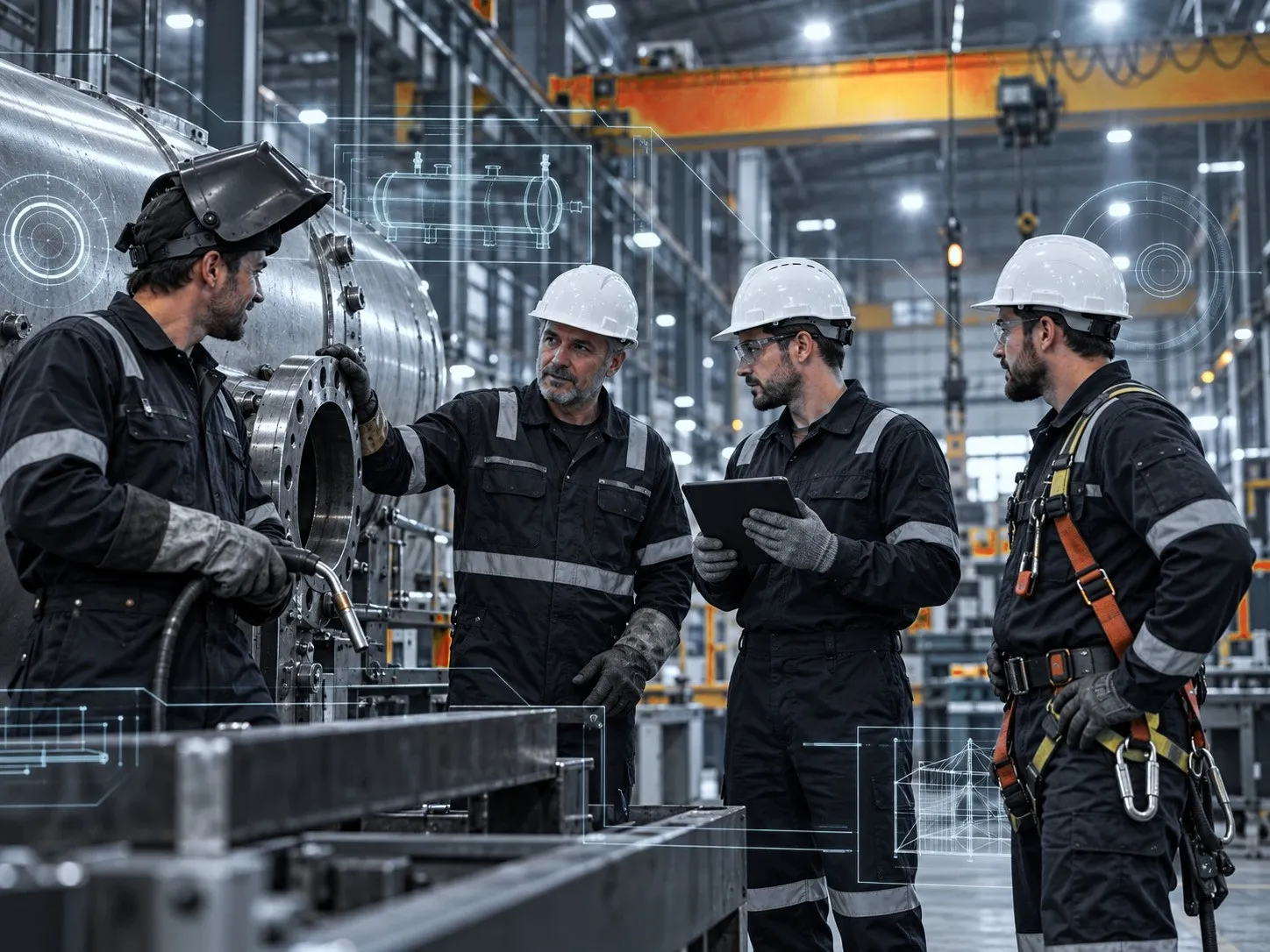
An industrial job is rarely one trade. A vessel, a pipe run or a new machine passes through several pairs of hands, and job titles change from plant to plant. Here is what a plater, a pipe fitter and a mechanical fitter each do, where welders and maintenance technicians fit in, and how a crew is organised on a plant.
What does a plater do?
A plater builds equipment from steel plate: marking it out from a drawing, cutting it, rolling or bending it, fitting the parts to size and, on most jobs, welding them. That is why you also see the title plater-welder. Boilermaker is the older name for the same family of work, and many companies use the two interchangeably.
Platers make tanks, vessels and heat exchanger shells. The skill that counts is fit-up: getting the parts square and to size before a weld is run, because a distorted item is expensive to correct. Our page on pressure vessel fabrication and boilermaking covers the work we take on.
What does a pipe fitter do?
A pipe fitter works on the lines that carry fluids and gases between equipment: process lines, steam, compressed air and water. The fitter sets out the route, prepares and cuts the pipe, fits up fittings, valves and flanges, supports and aligns the run from isometric drawings, and takes part in the pressure test. Joints are made by welding or by flanges, and a fitter who also welds is a pipe welder. Installed pipe cannot be turned, so it is welded in position, and pipe welders are qualified by position too.
A pipe fitter in industry is not a plumber, who works mostly on building services such as water and heating. The fitter works on process and utility lines in steel, stainless steel and other metals, to industrial codes. See our page on industrial pipework.
What does a mechanical fitter do?
A mechanical fitter puts equipment in place and makes it ready to run: setting machines on their bases and levelling them, aligning shafts and couplings, fixing them down and connecting them to their pipework, working from the general arrangement drawings and the manufacturer’s instructions. The fitter also fits guards and supports.
The same trade is sometimes called industrial mechanic or millwright. Between installations the fitter often strips down and rebuilds equipment, which is where it overlaps with the maintenance technician, so describe the tasks rather than the title. Our page on mechanical installation covers the work, and structural steelwork the steel around it.
Where welders and maintenance technicians fit
Welders join what the others fit. On many jobs the plater and the pipe fitter weld their own work. A separate welder comes in when there is a lot of welding or it needs a specific qualification, such as TIG on stainless pipework. Our article on coded welders lists what to check on a certificate, and the welding contractors page covers the service.
Maintenance technicians take over once the plant is running, or come in during a planned shutdown, to inspect, service and repair. The article on what a maintenance technician does covers the role, and our industrial maintenance page covers the service.
How a crew is organised
A job like this is run by a crew leader, called a supervisor, foreman or chargehand depending on the plant. The leader sets the order of the work, shares out the tasks, checks quality as the job goes and is the person the plant talks to.
A new stainless tank with its lines shows how the trades follow one another:
- The platers build the tank, or receive it from the shop.
- Mechanical fitters set it on its base, level it and align it.
- Pipe fitters run the lines to it, and pipe welders join them in position.
- Platers or steel erectors put up the access platform.
- A technician takes over once it is running.
On a small job one person may cover two of these roles. What matters is that the sequence is planned, because each trade waits on the one before.
Working with the plant
Before anyone starts, expect to settle the induction, the permits to work (hot work, confined spaces, work at height), the risk assessments and method statements, and the isolation of any live line or equipment. Spain requires companies that share a site to coordinate their safety measures, so the paperwork travels both ways, from you to the plant and from the plant to you.
We work with our own people and our own supervision. Your plant sets the access, the site rules and the dates.
Asking for a crew
Describe the work and the trades follow: what is to be built, fitted or welded, in which material, to which standard and by when. Our guide to choosing the right service for a job shows how to put that together, and about us explains how we work. Tell us about the job and we will say whether we can cover it.