
TIG vs MIG Welding: Which Do You Need?
Published on
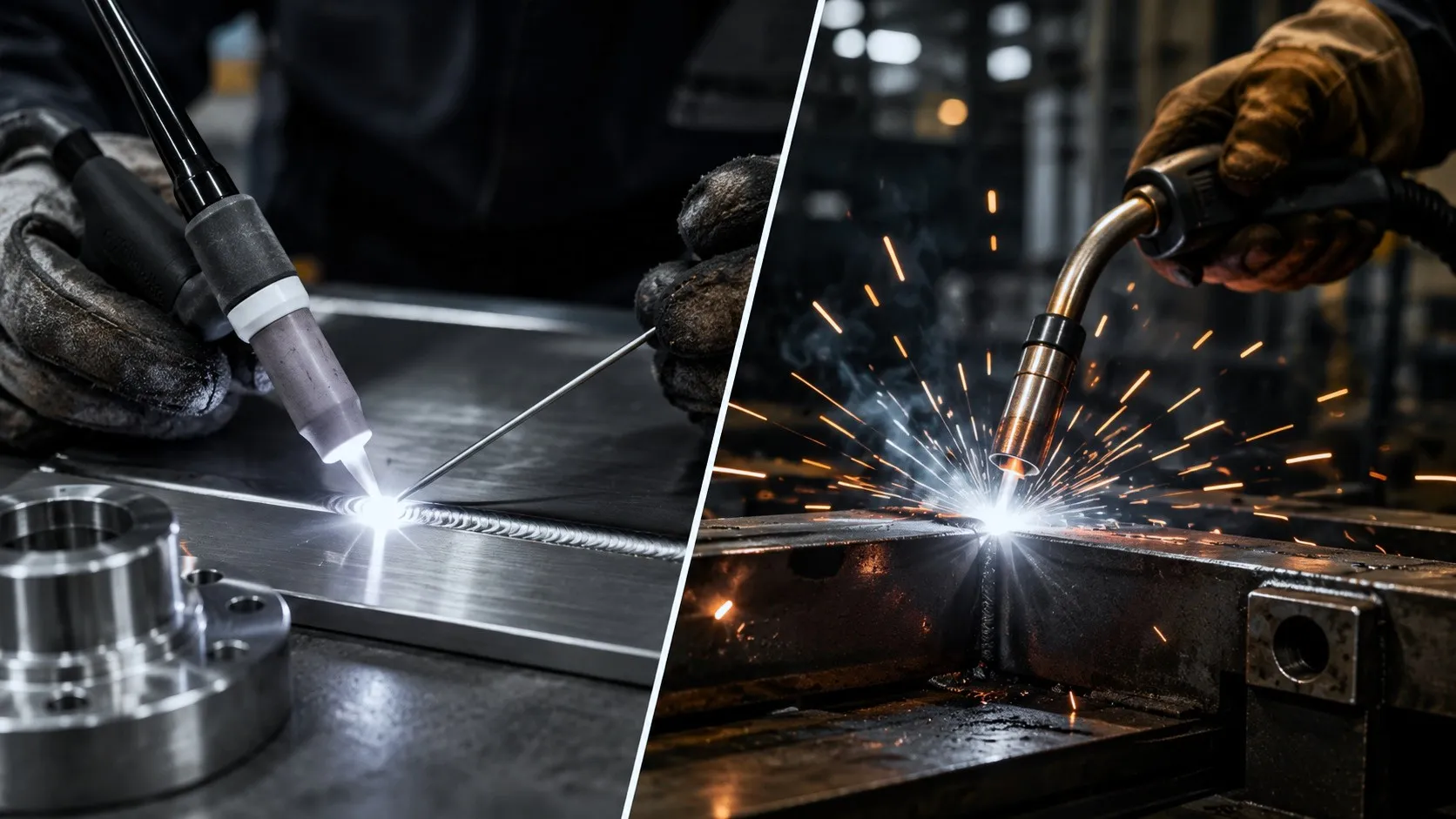
TIG vs MIG welding is a choice between control and speed. TIG gives you the cleaner, more precise weld and MIG gets more metal down in less time. Which one a job needs depends on the material, the thickness and the joint, and it is worth settling before you ask anyone to quote or to start.
How TIG welding works
TIG, also called GTAW, strikes the arc with a tungsten electrode that does not melt. The welder feeds a filler rod into the pool with one hand and holds the torch with the other, while a shielding gas, usually argon, protects the weld from the air. The welder also controls the current, often with a foot pedal or a switch on the torch.
It is slower than MIG and asks for more skill. In return it gives control over the pool, a clean finish and very little spatter, which is why it is used where the joint has to be right: thin sections, stainless steel pipework, aluminium and titanium.
How MIG welding works
MIG, also called GMAW, feeds a continuous wire through the torch. The wire is the electrode and the filler at once, and it melts as the weld is made, under a shielding gas. The welder holds the torch and pulls the trigger, and the machine feeds the wire.
It deposits metal quickly, is easier to learn and suits long runs and thicker sections. The finish is less refined than TIG, and spatter is more common. The gas depends on the metal: mixtures of argon and carbon dioxide are widely used on carbon steel, and pure argon on aluminium.
TIG vs MIG welding, side by side
- Speed. MIG is faster. TIG is slower, because each hand has its own job.
- Skill. MIG is quicker to learn. TIG takes longer to do well.
- Thin material. TIG gives more control and less risk of burning through.
- Thick material. MIG gets through long runs and heavy sections in less time.
- Finish. TIG gives the cleaner bead. MIG usually needs more cleaning afterwards.
- Materials. TIG is the usual choice for titanium and for critical stainless steel and aluminium joints. MIG is common on carbon steel and also used on aluminium and stainless.
- Outdoors. Both depend on gas shielding the pool, so wind is a problem for either process.
Do MIG welders need gas?
Yes, a MIG welder needs shielding gas to protect the pool. What people call gasless MIG uses a flux-cored wire that makes its own shielding as it burns. It is technically a different process, called flux-cored arc welding. It copes better with wind and is easy to set up, but it leaves slag to clean off and the finish is rougher.
What happens if you MIG weld steel with pure argon?
On carbon steel, pure argon gives an unstable arc, narrow penetration and more spatter than a mixture with carbon dioxide would. On aluminium it is the right gas. The gas has to suit the metal.
Which process for which job
- Stainless steel pipework: TIG, because the root of the joint needs control, and the back of the joint is normally purged with argon.
- Thick carbon steel and long runs: MIG, or manual metal arc where the access or the weather rule out gas.
- Aluminium: TIG for thin or critical joints, MIG for longer runs.
- Titanium: TIG, under inert gas that also protects the back of the weld.
- On site, outdoors or in awkward positions: manual metal arc (MMA), because it does not need a gas bottle.
What this means when you hire welders
State the process in your request, together with the material, the thickness and the position. A welder’s qualification is issued per process, material, thickness range and position, so a certificate for TIG on stainless steel does not cover MIG on aluminium. Ask for the certificate in the welder’s name and check it covers your job.
We weld carbon steel, stainless steel, aluminium and titanium with TIG, MIG and manual metal arc. Read more about our welding contractors service, or tell us about the job.